
Understanding Muscle Fiber as the Foundation of Performance
Muscle Fiber composition determines how the human body produces force, resists fatigue, and adapts to physical training. Every skeletal muscle is made up of thousands of individual fibers, each with distinct metabolic and mechanical characteristics. These fibers do not respond uniformly to exercise. Instead, training outcomes are shaped by which fibers are recruited, how frequently they are activated, and the intensity under which they operate.
We examine how different Muscle Fiber types function, how they adapt to resistance and endurance training, and how strategic programming influences hypertrophy, strength, and performance. This understanding allows us to design training systems that align with specific athletic and health goals.
Classification of Muscle Fiber Types
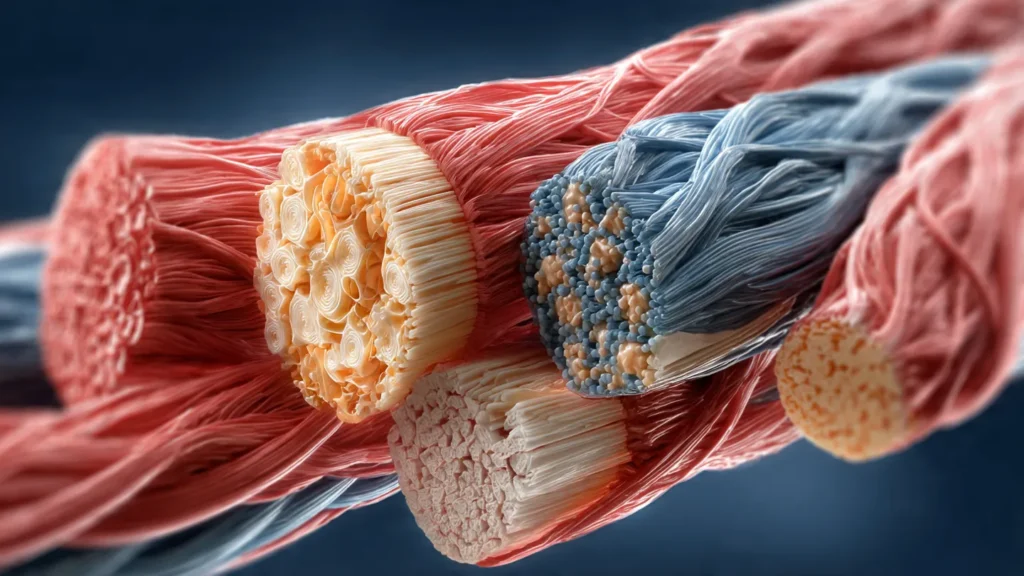
Skeletal muscle fibers are generally classified into three primary categories based on contraction speed and energy production. These categories coexist within muscles, though their ratios vary among individuals and muscle groups.
Type I Muscle Fiber (Slow-Twitch Fibers)
Type I Muscle Fiber contracts slowly and is highly resistant to fatigue. These fibers rely primarily on aerobic metabolism, using oxygen to generate energy efficiently over extended durations. They contain a high density of mitochondria, capillaries, and myoglobin, which support sustained muscular activity.
Type I fibers dominate in postural muscles and muscles involved in prolonged, low-intensity movements. Their structure supports endurance-based tasks such as distance running, cycling, and sustained isometric holds. While their force output is limited, their efficiency allows for long-term performance without rapid exhaustion.
Type IIa Muscle Fiber (Fast Oxidative-Glycolytic Fibers)
Type IIa Muscle Fiber represents a hybrid profile, combining characteristics of endurance and power. These fibers contract faster than Type I fibers while maintaining moderate resistance to fatigue. Energy is derived from both aerobic and anaerobic systems, allowing adaptability across a range of intensities.
Type IIa fibers respond strongly to training stimuli and are often the most adaptable in terms of hypertrophy and metabolic change. They play a central role in activities requiring repeated bursts of force, such as middle-distance running, team sports, and moderate-load resistance training.
Type IIx Muscle Fiber (Fast-Twitch Glycolytic Fibers)
Type IIx Muscle Fiber produces the highest force and contracts at the fastest rate. These fibers rely heavily on anaerobic metabolism, generating energy rapidly but inefficiently. As a result, fatigue occurs quickly.
Type IIx fibers are recruited during maximal or near-maximal efforts such as sprinting, heavy lifting, and explosive movements. While they possess the greatest potential for strength and size increases, they require high-intensity stimuli to remain functionally expressed.
Muscle Fiber Recruitment and the Size Principle
Muscle Fiber recruitment follows a predictable hierarchy known as the size principle. Lower-threshold fibers are activated first, with higher-threshold fibers recruited as force demands increase.
During low-intensity activity, Type I fibers perform the majority of the work. As intensity rises, Type IIa fibers are engaged, followed by Type IIx fibers during maximal exertion. This sequence ensures efficiency while preserving high-force fibers for tasks that demand them.
Training intensity directly influences which fibers are stimulated. Low-load, high-repetition exercise emphasizes endurance-oriented fibers, while heavy loads and explosive actions activate fast-twitch fibers more effectively.
How Resistance Training Influences Muscle Fiber Adaptation

Resistance training alters Muscle Fiber structure and function through mechanical tension, metabolic stress, and neural adaptation. Each fiber type responds differently depending on training variables.
Hypertrophy Across Fiber Types
Muscle hypertrophy occurs when fibers increase in cross-sectional area. Type II fibers, particularly Type IIa and IIx, demonstrate a greater hypertrophic response due to higher force production and sensitivity to mechanical overload.
Type I fibers also hypertrophy, especially under high-volume conditions. Sustained time under tension and short rest intervals increase metabolic stress, promoting growth even in endurance-oriented fibers.
Strength Development and Neural Efficiency
Strength gains result from both muscular and neural adaptations. High-load training enhances motor unit synchronization and recruitment of high-threshold Muscle Fiber populations. Over time, Type IIx fibers may shift toward Type IIa characteristics, improving fatigue resistance while retaining high force potential.
This transformation reflects the muscle’s effort to meet repeated demands efficiently, rather than a loss of power capacity.
Endurance Training and Muscle Fiber Transformation
Endurance-focused training emphasizes prolonged activity at submaximal intensities. This training modality enhances the oxidative capacity of Muscle Fiber by increasing mitochondrial density and capillary networks.
Type IIa fibers often adapt to behave more like Type I fibers, improving aerobic efficiency. This shift supports sustained performance and delays fatigue without eliminating the capacity for forceful contraction when required.
Type IIx fibers are less frequently recruited during endurance training and may decrease in relative expression unless high-intensity intervals are incorporated.
Training Variables That Shape Muscle Fiber Response

Several training variables determine how Muscle Fiber adapts over time. Strategic manipulation of these factors allows targeted development.
Load and Intensity
Heavier loads increase mechanical tension, favoring fast-twitch fiber activation. Lighter loads with higher repetitions increase metabolic stress, engaging a broader range of fibers over longer durations.
Volume and Frequency
Higher training volume promotes hypertrophy across fiber types. Frequent stimulation enhances protein synthesis and reinforces adaptive signaling pathways within the muscle.
Rest Intervals
Short rest periods increase fatigue and metabolic accumulation, enhancing endurance-related adaptations. Longer rest intervals preserve force output and maximize fast-twitch fiber recruitment.
Movement Velocity
Explosive movements preferentially recruit Type II fibers due to the rapid force demands. Controlled tempos emphasize sustained tension and fiber endurance.
Genetic Influence on Muscle Fiber Distribution
Muscle Fiber composition is partially determined by genetics. Some individuals naturally possess a higher proportion of fast-twitch fibers, while others exhibit endurance-oriented profiles. This distribution influences training responsiveness and performance potential.
While genetics establish a baseline, training significantly modifies functional characteristics. Fiber type expression is adaptable, allowing athletes and recreational trainees to improve across multiple domains with appropriate programming.
Practical Applications for Training Design
Understanding Muscle Fiber behavior enables precise training design. Strength-focused programs prioritize heavy compound lifts, low repetitions, and adequate recovery. Endurance-oriented programs emphasize volume, consistency, and aerobic efficiency.
Hybrid training approaches integrate multiple stimuli, ensuring balanced development. Periodization allows emphasis on specific fiber adaptations while maintaining overall performance capacity.
We apply this knowledge to structure training phases that align with performance cycles, injury prevention, and long-term progression.
Muscle Fiber and Recovery Considerations
Recovery capacity varies among fiber types. Fast-twitch fibers experience greater microtrauma and require longer recovery periods. Endurance fibers recover more quickly due to enhanced blood flow and oxidative capacity.
Sleep, nutrition, and active recovery strategies support optimal Muscle Fiber repair and adaptation. Adequate protein intake and energy availability are essential for sustained progress.
Long-Term Adaptation and Training Consistency
Muscle Fiber adaptation is cumulative. Consistent training reinforces structural and metabolic changes that persist over time. Sudden shifts in training style can reverse adaptations, emphasizing the importance of long-term planning.
We prioritize progressive overload, variation, and recovery to maintain fiber responsiveness and prevent stagnation.
Conclusion: Leveraging Muscle Fiber Knowledge for Optimal Results
Muscle Fiber behavior defines how the body responds to physical stress. By understanding fiber classification, recruitment patterns, and adaptive mechanisms, we optimize training outcomes with precision.
Strategic programming aligns intensity, volume, and recovery with desired adaptations. This approach supports strength development, endurance capacity, and overall muscular performance while respecting individual variability.